








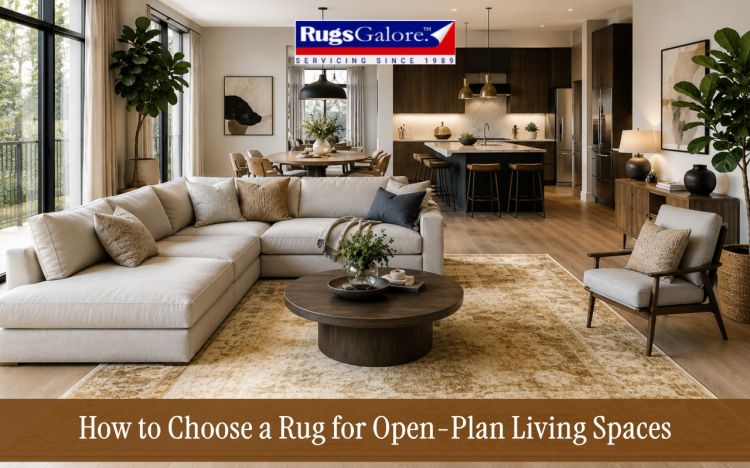
How to Choose a Rug for Open-Plan Living Spaces
Although open-plan living creates a beautiful, vast, airy environment since there are no physical walls, it might be difficult to establish limits in the areas used for various purposes. The good news is that you can easily distinguish areas of your living, eating, and working spaces by putting down rugs.
Choosing the right rug for an open-plan living space depends on its size, positioning, and colour. This guide will help you understand how to choose the right rug for your open-plan living spaces and factors to consider before choosing it.
1. Creating Distinct Areas while Retaining Unity
Making furniture pieces stand on their own in an open-plan is not always a great idea. Choosing appropriately sized rugs to position under furniture will make the purpose clear.
- Living Room: Thick area rugs help keep the sofa, coffee table, and armchairs in one corner perfect for chatting.
- Dining Space: A flat-weave or low-pile rug gives you a dining space and absorbs noise, protecting the flooring from chairs moving.
- Home Office or Reading Corner: Small or round rugs separate a desk or chair from the rest of the living area.
Design tips: Leave 30-50 cm of flooring between different rugs to make the room appear spacious.
2. Rug Size and Placement Guidelines
The greatest error in home decor is using the wrong size rug. A rug that is too small (sometimes called a "floating island" rug or "postage stamp" rug) minimises the perceived space of the room while making the furniture look disjointed.
|
Zone |
Recommended Placement |
Sizing Rule of Thumb |
|
Living Room |
All front legs of the sofa and armchairs should rest on the rug, or ideally all four legs for large rooms. |
200 x 290cm or 240 x 330 cm |
|
Dining Room |
The rug must extend past all sides of the table so dining chairs stay on the rug when pulled out. |
200 x 290 cm or 300 x 400 cm (Add 60 cm to table edges) |
|
Study / Reading Nook |
Center beneath the desk and chair or under a cozy armchair. |
160 x 230 cm or a 160–200 cm Circular Rug |
Rug Placement Guidelines in Different Rooms
- Living Room Ideas: The front legs of the seating should rest on the rug to create visual unity among the pieces. If there is sufficient space, the whole seating arrangement can be placed on a large shaggy rug or modern textured rug for warmth.
- Dining Room Rugs: Choose a low-pile or flat-weave rug. High-pile or plush rugs tend to trap crumbs and make sliding chairs difficult.
- Small Spaces: Use round rugs under curved chairs or small round tables. The curved edges emphasise the contrast with linear lines and soften sharp rectangular architectural lines.
3. How to Coordinate Different Rugs in One Room
When you use different rugs in open-plan designs, you should have balance about their placement so that they don't look like a showroom.
Keep Colours Uniformed
Identify two or three main colours in your furniture, decor, or paint, then use these colours in your rugs in the same space. For instance, if your main rug used in your living room includes navy and warm oak colours, you should use a second rug for your dining room with a basic cream colour and navy hints.
Experiment with Textures and Designs
You don’t have to use matching rugs because similar rugs will make your room look boring and monotonous. You can use different textures and styles and keep your colour palette synchronised.
- Modern Rugs Loved by Melbourne Homes: For instance, use a big, geometric modern rugs in your living room while choosing a neutral-coloured rug for your dining room.
- Classic Rugs with a Twist: For example, place a decorative old-fashioned rug in your living space while placing a natural jute rug in your kitchen or dining room.
- Fluffy Rugs for Comfort: Use shaggy rugs in areas where you don’t experience a lot of activity for maximum comfort.
4. Things to Avoid When Using Rugs in Open Plan Areas
- Rug Sizes: Make sure you measure the space where you want to place a rug, as well as the furniture that will go along with it. Ideally, choose a large rug that would make your open space feel bigger.
- Lack of Rug Variety: Avoid buying two identical rugs for two adjacent areas. Instead, mix and match with different styles, such as a patterned rug mixed with a solid rug.
- Rug Placement Oversight: Make sure to check door clearance before settling for a thick pile. Avoid placing rug edges on paths that are very frequently crossed.
- Rug Underlay Ignorance: With open-space area rugs, it will be necessary to consider that people can walk all over the rugs, and consequently, slip-resistant underlay is necessary.
Choosing the Right Rug for Your Open-Plan Space
Finding the right rug for your open-space area is all about striking the right balance.
If you want to masterfully organise an open-plan living space, you need to arrange some separate zones to keep some sense of harmony without losing style. In order to achieve that, you should not forget about a proper rug size and rug placement.
Mixing different styles can help you stay in line with your personal tastes while keeping everything in balance and ensuring that different areas of your home cohere with one another.
Ready to transform your home with premium rugs for open-plan living spaces?
If you are unsure of the right rug size or the way it should be combined with different textures of the room, our Rugs Galore team at Blackburn and Dandenong are ready to assist you. It is time to explore our wide range of products!